Palm Oil, Pineapple, and the Politics of Agriculture in Costa Rica
Author: Natalie Leonard
Each of the photos presented in this essay captured a scene that sparked a connection for me between what I’ve learned within the UPEACE Sustainable Agriculture course and the current realities of the agricultural system within and beyond Costa Rica.
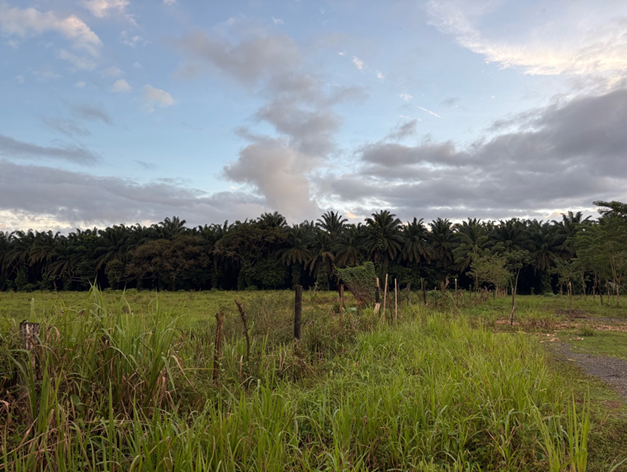
Photo One was taken on the family farm of my host mom in Puerto Jimenez, Costa Rica. In this photo, her brother’s pastureland for his small herd of cattle disappears into hectares and hectares of an oil palm plantation. The stark line of oil palm is ominously positioned, like a uniformed army on the front line. The nonnative trees are closely packed together, a united homogenous front creating a darkness where within other life struggles to survive and that which does is intentionally destroyed. The juxtaposition this monoculture plantation, void of biodiversity, situated just a few kilometers from Corcovado National Park, often described as one of the most biodiverse places in the world, is interesting. My host mom shared with me that her uncle owned this land for many years, but eventually sold it to Palma Tica, a subsidiary of Numar Group, Costa Rica’s principal palm oil producer and the self-proclaimed “original motor of palm oil cultivation in Central America” (Grupo Agroindustrial Numar S.A., n.d.).
Within the history of Numar Group and the palm oil industry in Costa Rica, the impacts of globalization and agro-industrial consolidation of land are reflected. The company originated from the United Fruit Company, which transitioned from bananas to African palm in Costa Rica in the 1930s, in part because the soils became too depleted to continue to grow bananas due to overuse of copper-sulfate fungicides (World Rainforest Movement, 2016). Numar Group was founded by Richard Johnson from the United States in 1951, near the start of Costa Rica’s Green Revolution. Its rapid growth was fueled by Green Revolution technology as well as neoliberal trade policies and global demand for palm oil. Today, the Numar Agro-industrial Group has expanded to include four companies, one of which, called ASD, is fully dedicated to the development of agricultural technology and the creation of new varieties of “high yielding oil palm seeds and clones” (ASD Costa Rica, 2023). This phrasing of “high yielding” seeds and the company’s goal to “introduce and develop new crops in the American humid tropics” on ASD’s website, sounds a lot like the goal of Normal Borlaug with his high-yielding wheat during the Green Revolution (ASD Costa Rica, 2023; Perfecto, Vandermeer, & Wright, 2009). ASD is now the main supplier of oil palm seed in Latin America, and according to their website, “Since its creation, the company has supplied more than 350 million seeds (equivalent to about 2 million hectares of commercial plantations) in 45 countries in America, Asia, Africa, and Oceania, which represents around 8.5% of the total area planted in the world” (ASD Costa Rica, 2023).
In 2023, Costa Rica was the eighth largest exporter of crude palm oil in the world (World Bank 2023). These figures show how influential a single company can be in the expansion of monoculture and the shocking realities of corporate control and consolidation of land resulting from neoliberal policies. As described by Holt-Gimenez (2017), “The corporate food regime is characterized by the monopoly market power and mega-profits of agrifood corporations, globalized meat production, the emergence of agrofuels, and the devastating expansion of palm and soy plantations” (Holt-Gimenez 2017, 54). In a small country like Costa Rica, this multinational company owns over 24,000 hectares of its own plantations and runs 17,000 hectares with associated producers (Grupo Agroindustrial Numar S.A., n.d). With 60% of the cultivated area of palm oil in Costa Rica controlled by foreign investors, it is shocking to think about the amount of natural resources, land and water, being used from Costa Rica, all for a crop profiting foreigners and produced for export (FAO, 2014).
While palm oil production in Costa Rica creates significant social and ecological harms, the scale and intensity of the impacts of pineapple are even greater.
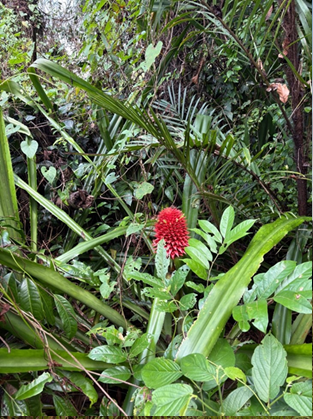
Photo Two features wild pineapple, growing in Corcovado National Park. What struck me about this photo is how far pineapple cultivation has come from how it appears in this photo. Costa Rican pineapple plantations today are characterized by hectares of monocrop cultivation and hundreds of rows of large, agrochemical-soaked fruits sitting in bare dirt. In contrast, this wild pineapple is growing within an a massively biodiverse ecosystem, with too many plants to count in this image.
Like palm oil, pineapple production in Costa Rica has intensified due to the pressures of increasing global demand, free trade policy, and the domination of transnational corporations like
Del Monte. Now the second largest exporter of this fruit globally (Sylvester, Breitling, & Ramin, 2024), Costa Rica faces the challenge of whether to prioritize continued economic growth through the expansion of this cash crop, or to regulate to safeguard the wellbeing of the communities whose land and water is being sacrificed to this production. Unfortunately, as explored by Ramin and Sylvester (2024), the former is often put first, with dire social, environmental, and political consequences.
Unregulated, uncontrolled expansion of transnational pineapple agribusinesses is responsible for soil depletion and erosion, and the contamination and exploitation of water sources (Ramin and Sylvester, 2024). These impacts have devastating effects on the local communities who rely on this land and water. This injustice brings forward the question: who has the right to control these resources? According to the UN, communities have a right to “sufficient, safe, acceptable, physically accessible, and affordable water (UN-Water, n.d.). But what we see in reality is much more nuanced and political, as outlined by Ramin and Sylvester (2024), highlighting that 98% of water concessions in the Volcán district of Buenos Aires, Costa Rica are controlled by Del Monte.
These cases within Costa Rica parallel the global examples seen in the Chile’s privatized water system and the weaponization of water in Palestine (DW Documentary, 2025; The Intercept, 2022; Al Jazeera, 2023), which show that scarcity is often not the product of insufficient water but of unequal distribution of the resource. The pineapple industry exemplifies how industrial agriculture, when left unchecked, can reproduce systems where access to water is determined not by a community’s need or the planet’s ecological limits, but by the interests of powerful corporate actors.
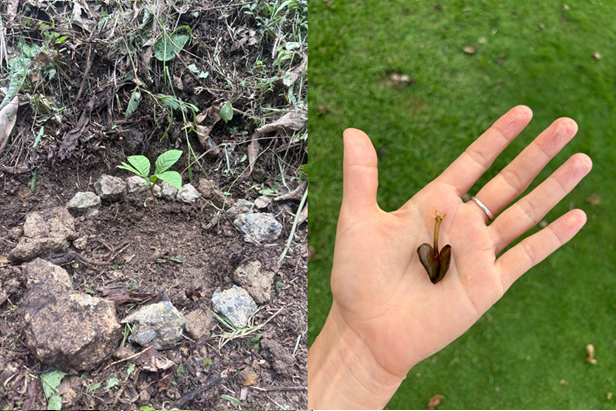
These two photos represent my conviction that a better, sustainable, justice-focused food system can be built. Photo three on the left, was the tree that I had the joy of planting with the help of Don Pedro. Photo four made me reflect on how our seeds and the deep history they hold are critical to climate resiliency and culturally appropriate and accessible food systems. Creole seeds, and the people who have stewarded and saved them throughout time, are the beating heart of a sustainable food system, and we must fight to keep them in the hands of their communities. Rowen White in “Planting Sacred Seeds in a Modern World,” describes seeds as sacred pieces of her culture and the history of her people. She calls this history encompassed within the seeds, the “intergenerational memory, the ‘seedsongs’ that are carried in the blood and bones of our reciprocal relationships with our food and seed plant relatives, who have been helping Indigenous peoples since time immemorial” (White, 2019). I am reminded by the wisdom that the Huetar elders have shared with the UPEACE community, with their words, plants, and teachings.
The first sprout that emerges from a seed is called a radicle, the part of the plant that develops into the primary root. I think this name is symbolic, as agroecology, urban gardening, community gardening, learning how to grow your own food, sharing this knowledge, sharing the food, saving the seeds, safeguarding these traditions, are all acts of radical resistance against the oppressive, industrial food system we’ve been handed.
These movements have taken root and will continue to grow, if we join in to support them.
List of references:
Al Jazeera English (2023). Is Israel Weaponising Water in Palestine? | People & Power Documentary. https://www.youtube.com/watch?v=HSbnniboAXo
ASD Costa Rica. (2023, February 2). Company profile (Compact Seeds & Clones). https://asdcr.com/wp–content/uploads/2023/02/Company–Profile–ASD–20230202.pdf
DW Documentary (2025). Rivers at risk – Water crisis on four continents. https://www.youtube.com/watch?v=gzTxlQGbiyc
FAO. (2014). The land market in Latin America and the Caribbean: Concentration and foreignization. Food and Agriculture Organization of the United Nations. https://openknowledge.fao.org/server/api/core/bitstreams/3a7eb770–abba–405e–a2226c56a2e5ff56/content
Grupo Agroindustrial Numar S.A. (n.d.). Quiénes somos. Grupo Numar. https://gruponumar.com/quienes–somos/
Holt-Gimenez, E. (2017). A Foodie’s Guide to Capitalism: Understanding the Political Economy of What we Eat, Monthly Review Press.
Perfecto, I., Vandermeer, J. H., & Wright, A. L. (2009). Nature’s matrix: linking agriculture, conservation and food sovereignty. New York: Earthscan.
Ramin, C. & Sylvester, O. (2024). Water and Industrial Agriculture: A case study of pineapple in Buenos Aires, Costa Rica. In: (Sylvester, Breitling, & Ramin, Eds.). Water Emergency: Case Studies and Global Perspectives. University for Peace Press.
Sachs, C., & Patel-Campillo, A. (2014). Feminist food justice: Crafting a new vision. Feminist Studies, 40(2), 396-410.
Sylvester, Breitling, & Ramin, (Eds.). (2024). Water Emergency: Case Studies and Global Perspectives. University for Peace Press.
The intercept (2022). In Chile, Even Water is Privatized. The New Constitution Would Change that. Youtube: https://www.youtube.com/watch?v=X-W_IYSe6zY
UN-Water. (n.d.). Human rights to water and sanitation. UN-Water. Retrieved November 17, 2025, from https://www.unwater.org/water–facts/human–rights–water–and–sanitation
World Bank. (2023). WITS Comtrade: Exports of HS 151110 (Crude palm oil) – world total [Data set]. World Integrated Trade Solution. https://wits.worldbank.org/trade/comtrade/en/country/ALL/year/2023/tradeflow/Exports/partner/ WLD/product/151110
World Rainforest Movement. (2016, October 20). Expansion of oil palm plantations as state policy in Central America. WRM Bulletin, (226). https://www.wrm.org.uy/bulletinarticles/expansion–of–oil–palm–plantations–as–state–policy–in–central–america
White, Rowen. “Planting Sacred Seeds in a Modern World: Restoring Indigenous Seed
Sovereignty” in Indigenous Food Sovereignty in the US: Restoring Cultural Knowledge, Protecting Environments & Regaining Health. 2019. Ed. Mihesuah
Author’s short bio