
Thinking the Unthinkable
Thinking the Unthinkable Author: Fraser Gray Originally published at Peace and Conflict Monitor on 05/01/2006 Officially since 1967, and arguably before then, the US has considered Israel a key ally in the Middle East. As the primary, and by far the largest, recipient of US military aid and diplomatic support since that date, Israel has […]
Iran and the Centrality of the IAEA
Iran and the Centrality of the IAEA Author: Dr. Aldo Zammit Borda Originally published at Peace and Conflict Monitor on 03/15/2005 Introduction In February 2005, Iran rejected an EU-3(1) offer that would have limited its nuclear capabilities, to replace its heavy-water nuclear reactor with a lightwater reactor2. This offer was made as part of the […]
Kyoto Bites
In the seven years since the Kyoto Conference the scientific debate over the reality of global warming has been largely settled. Yet the effectiveness of the treaty that has been rejected by the U.S, and which excludes the worlds fast growing developing economies remains widely questioned. Kyoto’s leading critic, the U.S Government, recently admitted that global warming is taking place and that this is a result of human activity.
Evangelicals Invade Iraq
United States based evangelical NGOs and evangelical churches alike mobilized their forces to distribute humanitarian aid, as well as a plethora of Christian literature and an army of missionaries. As the efforts were underway, the onlooking Muslim world suspiciously questioned such motive
Driving Deterioration. How the car culture contributes to escalating human misery
The author asks the reader to consider how the car in the last 100 years has been responsible for turning an area of natural landscape in the U.S. the size of Ohio, Indiana, and Pennsylvania into concrete or asphalt. To consider that it has been directly responsible for injuring 250 million, nearly equivalent to the current population of the U.S., and killing more than have died in all the wars in which the country has fought. To consider that the widespread use of this same contraption burns 8 million barrels of oil daily, making the U.S. increasingly dependent on and entangled with a severely unstable world region. To consider that it kills one million wild animals every week. The automobile continues to be responsible for myriad negative effects that, when assessed rationally, far outweigh the benefits. And the rest of the world is close behind…
The business of war
Saddam was captured by regular troops. However, underlying the tactical and strategic operations in Iraq, has been and is an emerging new generation of US military tactics that relies increasingly on sophisticated information and communication technologies, which are not only developed and produced by the civilian industry, but can in fact only be maintained and operated by civilian experts.
Complexities
Your average CNN-watching American may be able to report the latest on soldiers killed or Iraqis successfully “found, killed or captured,” but you’d be hard pressed to find an average American who could tell you how the scene is really unfolding. How complex is the situation?
Talking Peace for North Korea
The announcement last week that China, Japan, North and South Korea, Russia and the United States will meet within one month for multilateral talks on the North Korea issue has been greeted worldwide with unbridled optimism (‘A Welcome First Step on the Path to Korean Peace’, South China Morning Post, 2 August, 2003). A military solution has largely been ignored or downplayed, with the exception of a predictably hawkish article by former CIA Director R. James Woolsey in the Asian Wall Street Journal, detailing why an invasion of North Korea would be logistically easier and politically less sensitive than the invasion of Iraq.
The Marshall Plan Mystique
The war in Iraq had not even begun when public discussion began on the rebuilding of Iraq by the US. Is this to be another “not the Marshall plan”? David Ekbladh calls for rethinking the approach to so-called Marshall Plans.
Under the Guise of Protecting Human Rights and Establishing Democracy: US Intervention in Sri Lanka
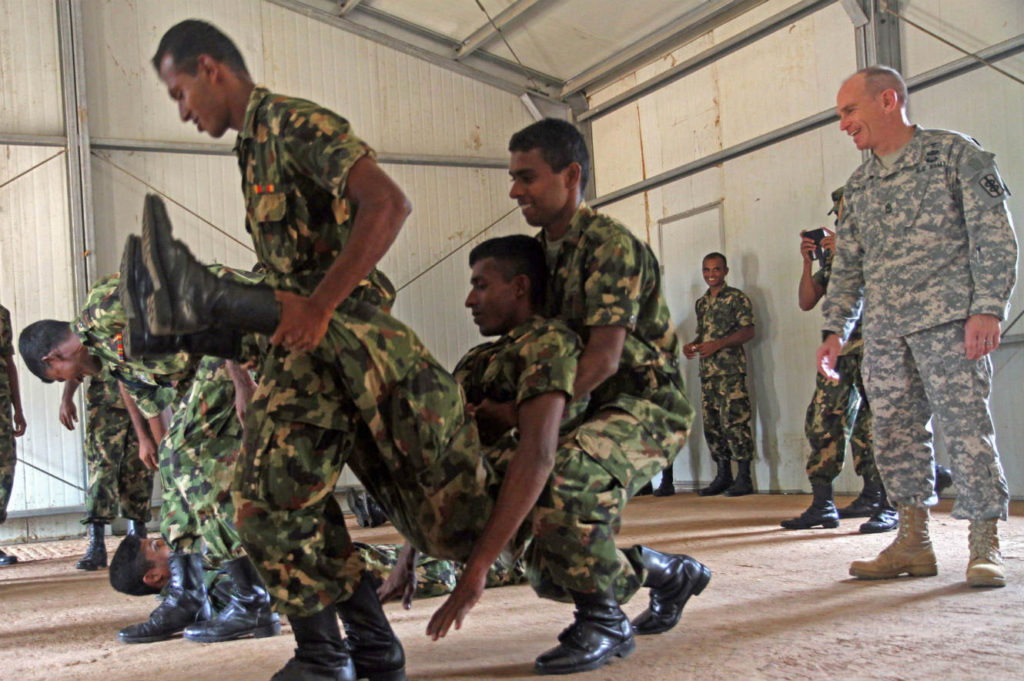
The paper argues that strong US intervention in Sri Lanka after the end of the island’s armed conflict in 2009 is not based on altruistic efforts to protect human rights as presented in mainstream sources, but stems from deepening US geopolitical and ideological interests in the Indian Ocean region. Keywords: Sri Lanka-US relations, US foreign policy, North-South relations, Neoliberal policy, interventionism, Indian Ocean, US-China relations