
CANDIDATO DOCTORAL DE UPEACE – HASSAN SHEKH MOHAMUD GANA LAS ELECCIONES PRESIDENCIALES DE SOMALIA
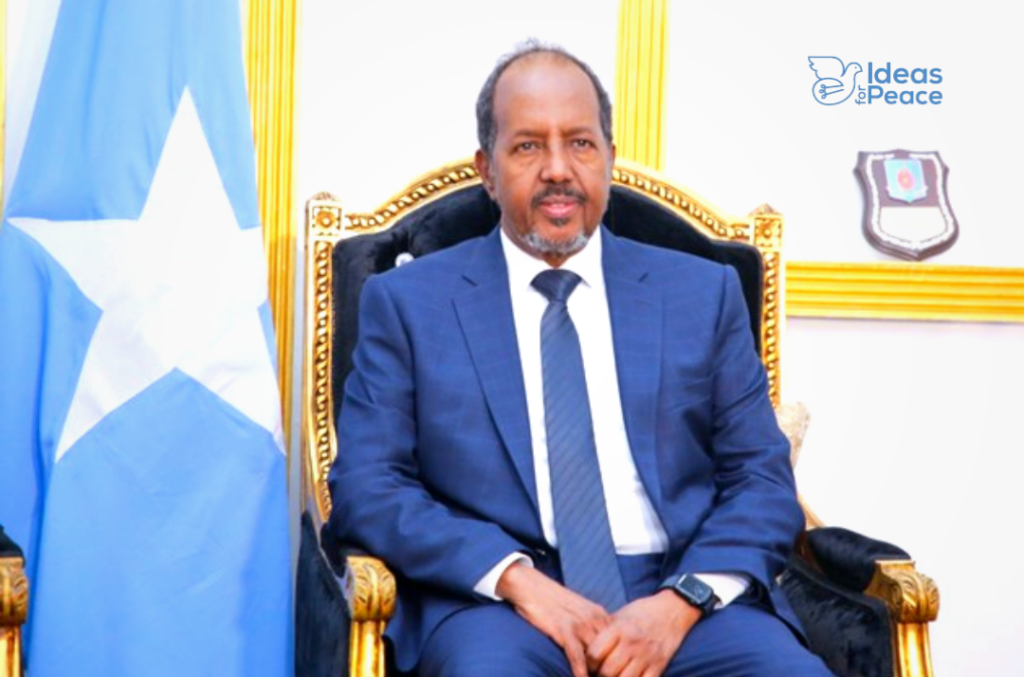
UPEACE Doctoral Candidate – Hassan Shekh Mohamud wins Somalia’s presidential election Author: Samuel Ewusi Somalia’s new President Hassan Sheikh Mohamud was declared the winner of the Presidential election on Sunday, May 16th, 2022 to become the country’s new president. Mohamud beat the incumbent Mohamed Abdullahi Farmajo by 214 votes to 110 in the third round […]
Peace and Order in Somalia
Key words: Ethiopia, USA, Somaila, foreign occupation, terrorism, insurgency, political Islam, financial crisis, peace, democracy, horn of Africa, regional conflict, Islamic Courts Union (ICU), Transitional Federal Government (TFG)
Somalia’s message to the world: Get Ethiopia off our back
Ethiopia’s occupation of Somalia has recieved significantly less attention from world media than other ongoing conflicts. Afyare Abdi Elmi discusses some of the reasons behind this silence and warns against the consequences of its continuation.
Balkanization and Subjugation of Somalia
Somalia’s Special Envoy to the United States, Abukar Arman, provides first-hand commentary on Somalia’s hard-hit reality. Rejecting conventional confines proposed by the interest groups within international community and the “political vultures of the 21st Century”, he calls on Somalia’s Traditional Federal Parliament to assert itself against the limiting aspects of the Kampala Accord and, instead, stand strong to support the will of the Somali nation.
Operation ‘Degrade Al-Shabaab Capacity’: Kenyan Mission with No Winners, But Losers
If there is any lesson that the war on terror, now ten years old and counting, has brought to the surface, it is that conventional military is the worst possible tool to fight an insurgent group that coexists with and feeds from a complex crisis. The harder you hit the perceived stronghold with conventional strategies and weapons, the more complex the situation becomes. In this article, Patrick Mugo Mugo asks: what happens when you decide, as the Kenyan government, to go after the tail of Al-Shabaab and not its head? If we can assume that Al-Shabaab is an invisible creature of a complex crisis, what does that tell us about Somalia’s dithering Transitional Federal Government, which the Kenyan incursion purports to help? Why should the Kenyan government, well aware of American experience in Iraq and Afghanistan, invade Somalia following the same script without even editing or rephrasing it? Even if the Kenyan military succeeds in ‘degrading Al-Shabaab capacity’, who will fill the void created in southern Somalia? But before all that, is it Al-Shabaab that is the problem, or is it the analyses that have come forth since al-Shabaab became credible threat?
Is Global Media Setting the Agenda for UN Peace Keeping Operations: Revisiting the UNOSOM Debacle
Is Global Media Setting the Agenda for UN Peace Keeping Operations: Revisiting the UNOSOM Debacle Author: Dominic Pkalya Originally Published at Peace and Conflict Monitor on: 11/30/2006 The United Nations Peace Keeping Operations have received ambivalent reactions. Many have welcomed it as a necessary precondition and process for not only mediating in a nascent […]
Somalia: Post-transitional Political Fault Lines
Somalia Special Envoy Abukar Arman reports on public perceptions of government in Somalia, the many challenges facing the states and communities in the region, and the threat of violence emanating from the fault lines of religion, ethnicity, economics, and nationalism.
The Year 2003: A Beacon of Hope in Eastern Africa
With the year 2003 drawing to an end in less than two months, Ferdinand Katendeko, despite the history of conflict and simmering violence in many parts of the region, looks at the countries that compose the Inter Government Authority on Development (IGAD), and finds much to be hopeful about.
Islamic Courts Union was Better Placed to Pacify Somalia
Islamic Courts Union was Better Placed to Pacify Somalia Author: Dominic Pkalya Originally Published at Peace and Conflict Monitor on: 04/17/2007 When the Islamic Courts Union (ICU) was driven out of Mogadishu in December 2006 by a combination of Ethiopian and the Transitional Federal Government forces, many pundits were quick to note that Somalia has […]
Ending ‘Doormat Politics’ In Somalia
Somalia has been making political and economic progress recently, with an age of peace and prosperity seemingly on the horizon. What is necessary now, according to the author, is for the Somali people to put aside the division and depression left over from years of traumatic conflict and insecurity and embrace the future.