
Rethinking Agrarian Futures through Local Action (ReAL) in Costa Rica
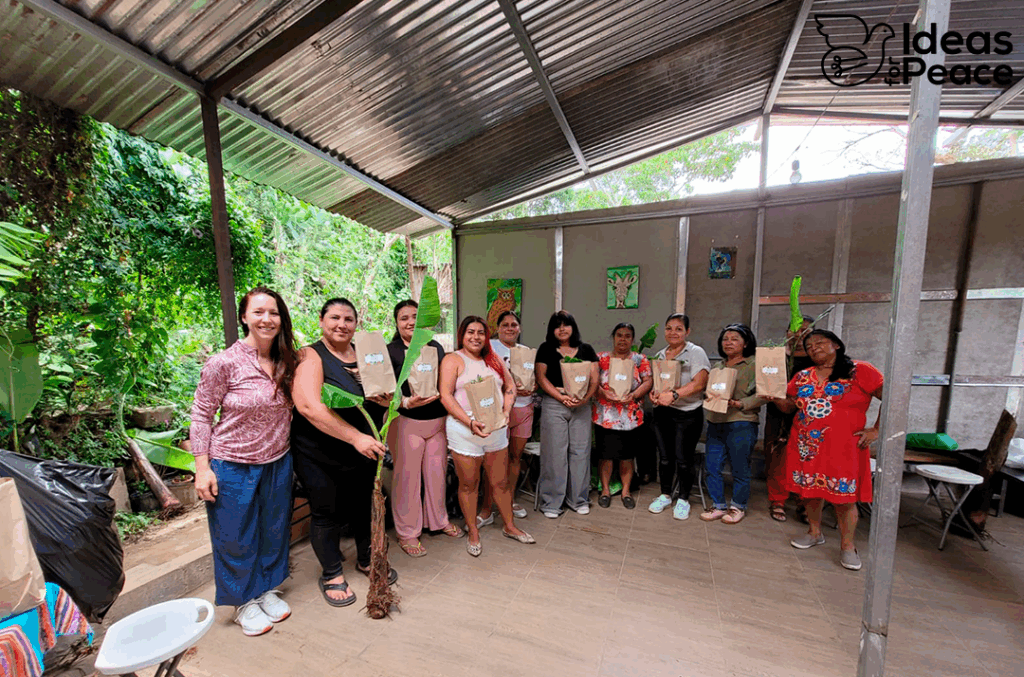
This article shares the experiences of three Indigenous women’s groups that are actively defending their lands and practicing food sovereignty in Costa Rica; these experiences take place within a project from UPEACE’s Department of Environment and Development with the support of the IHE Delft Institute for Water Education.
Food Security and Conflicts. Case Study: Anglophone Crisis, Cameroon
Food Security and Conflicts. Case Study: Anglophone Crisis, Cameroon Author: John Carlvin Piyinchu There is a tragic link between conflict and hunger and how it still pervades far too much of the world. We need better and quicker access in all conflict zones, so we can get to more of the civilians who need our […]
Nepal’s Special Security Plan: Political Stunt?
An independent commentary on recently introduced the Special Security Plan (SSP) of Nepal.
Building Respect for the Sheriff
Even in pursuit of the most laudable purposes, the use of military force exacerbates rather than transforms conflict, and perpetuates the cycle of violence and injustice. This is true in compelling cases as well, such as efforts to thwart gross violations of human rights, or for other humanitarian purposes.
It Doesn’t Rain, It Pours
Catherine Cheweza reflects on her experiences as a woman from Malawi travelling to Costa Rica.
Is the overseas deployment of Japan’s Self-Defense Force (SDF) illegal? Rethinking the Japanese contribution to international peace and security
Noriko Hashimoto discusses the legal and political arguments around the deployment of Japan’s self defense forces (SDF) for overseas missions, going beyond the constitutional debate to question the broader concept of national contributions to international society.
Dams: providing or destroying water security?
For over three or four decades, there have been propagandists and antagonists for the construction of dams all over the world. Dams were presumed to evolve with the world as a product of its socio-economic development. History has shown us that dams’ construction is not a recent phenomenon but has existed for sometime, especially with the discovery of the 8,000 year old irrigation canal in the Mesopotamia area.
This paper examines water security as a concept of environmental security and also analysis through history the importance of dams before the development of the “now concept of dams” and also analysis the role of dams in the present concept with positive and negative impacts on water security. The paper ends by identifying the need of consideration of water security in the management of dams.
Keywords: Dams, water, security, irrigation and development.
Food Crisis in the Republic of Niger: What needs to be done?
Food crises in the Republic of Niger have been on the rise. Much is being done to alleviate this situation, especially with food aid. Though necessary for immediate relief, this is not a long lasting solution for the country on the whole or specific regions such as northern Niger. It is therefore essential that this landlocked country looks for alternative methods of subsistence in order to improve on the current situation of about two million people on the verge of hunger.
Key words: Food insecurity, sustainable livelihood, and development
Men are an influential factor in households and community food security in the Center Region of Cameroon
For centuries the problem of food insecurity in Cameroon has been considered the woman’s problem to resolve. Men have failed to understand that they too play a crucial role in improving household and community food security because they are in control of all assets. It is therefore important to sensitize men on their key role in improving household food security and in turn they will on their own a long side women change destructive traditions and social norms.
Keywords: Gender, food security, sustainable livelihood
The Prospects for Peace and Security in the 21st Century
“Those of my generation who have been struggling in the international system for two or three decades cannot claim to have achieved a world to the measure of our hopes. I fear that, in spite of the undoubted progress made, we will leave to our successors a difficult and dangerous world which still suffers from abiding poverty for millions, injustice and threats to peace. You will have to face, directly or indirectly, the challenges and problems which we will leave in your care…”