
Afghanistan Beyond Bonn: Keep the Champagne Corked
Recent elections in Afghanistan went off without a hitch, but the country – currently with a development ranking of 172 out of 178 – is still very much in the woods. The crime rate is high and poppy cultivation is on the rise. Insurgency violence is growing as well, with 50 US soldiers killed in the first half of 2005, compared to 60 soldiers killed in the first three years following the 2001 invasion. Even as the newness of the Afghan mission fades, the international community should dig in: There’ve a long way to go yet.
It’s not over. Reports that Afghanistan is at peace, articles on the “establishment of democracy” are everywhere in western media. However these claims, too often made by journalists ‘in the field’ just long enough to get the dateline for big events like the recent elections, must be read in the context of a continually emerging state of civil war.
The Bonn conference in December 2001 after the collapse of Taliban rule envisaged, “the establishment of a broad-based, gender-sensitive, multi-ethnic and fully representative government”, which has in theory taken place. The most important aim of that same conference, though, was the establishment of peace and security in the country. Yet the elements of war still exist, and only the presence of ISAF (International Security Assistance Force) has prevented possible civil war. Democracy has arrived in Afghanistan only in name. The reality is much messier, particularly in the south and east.
The Mizrahi – Palestinian Connection, Part I
holarly analysis of the Israeli-Palestinian conflict has depicted it as a conflict between two homogenous entities, namely Israel and the Palestinians. However, scholars largely ignore the impact of the “inner-Israeli” conflict between Mizrahim and Ashkenazim on the “external” conflict between Israelis and Palestinians. Not only are the Mizrahim excluded from the peace process itself, but academics also fail to research the role they play in the conflict, while their occasional public role is that of extremely right-wing “Arab-haters” who prevent the Ashkenazi-dominated “liberal peace camp” from reaching a solution– hence they are portrayed as an obstacle to peace .
Iran and the Centrality of the IAEA
Iran and the Centrality of the IAEA Author: Dr. Aldo Zammit Borda Originally published at Peace and Conflict Monitor on 03/15/2005 Introduction In February 2005, Iran rejected an EU-3(1) offer that would have limited its nuclear capabilities, to replace its heavy-water nuclear reactor with a lightwater reactor2. This offer was made as part of the […]
Religions and War
The study of religions and war is somewhat inchoate, yet for many years scholars have noted the important role religion plays in national, ethnic and international conflicts. Many have recently pointed to the use and abuse of religious symbolism by politically motivated leaders who employ religious language as a means of generating support for purportedly righteous causes.
We have become increasingly aware that when conflicts are couched in religious and moral language, followers often quickly and enthusiastically fall in line many willing to make ultimate sacrifices to fight on God s behalf, or at least on God s side as defined by their leaders.
Whether such political leaders are sincere in espousing religiously-imbued rhetoric or whether they are simple demagogues, the approach clearly works. It works to a great extent because it seems that many people, no matter what their political leanings, prefer to reduce complex socio-economic, or political conflicts into a zero-sum values game of right and wrong.
The Japanese Constitution as Peace System
The wars in Asia would seem to demand that certain European countries, the U.S., and Japan all re-examine the value systems that presumably provided the justification for those wars. Many situations of “instability” in this century were actually based on the preconceptions and deeds of the nations that applied that label. Now as ever, if a country has reason to be opposed to something, it will typically display a tendency to assume that other countries are engaged in strategic designs or acting from an adversarial position.
Post tenebras lux
The Burundi war is sordid like all the other wars in the world. For this reason it must not be singled out. Burundi is plunged into mourning by a violence that the international community, out of ignorance or oversimplification, tends to simply portray as an ethnic war between Hutus and Tutsis, fanned by ancestral antagonism between these two communities. It’s utterly wrong. The Burundi war is complex and frightfully modern. It is a war for trifling political power and control of the resources. It simply uses the most fallacious pretexts (ethnic group, region, political affiliation) to disguise its true face. In so doing, it utterly resembles so many other armed conflicts in the world
Cowboy Stupid
Matthew Norton defends bad grammar and argues against stupidity.
The Day War Broke Out
News editor, Joseph Schumacher, checks the editorials around the world on THE DAY WAR BROKE OUT.
War is a Remix: Organized violence from blood sacrifice to cyberattacks
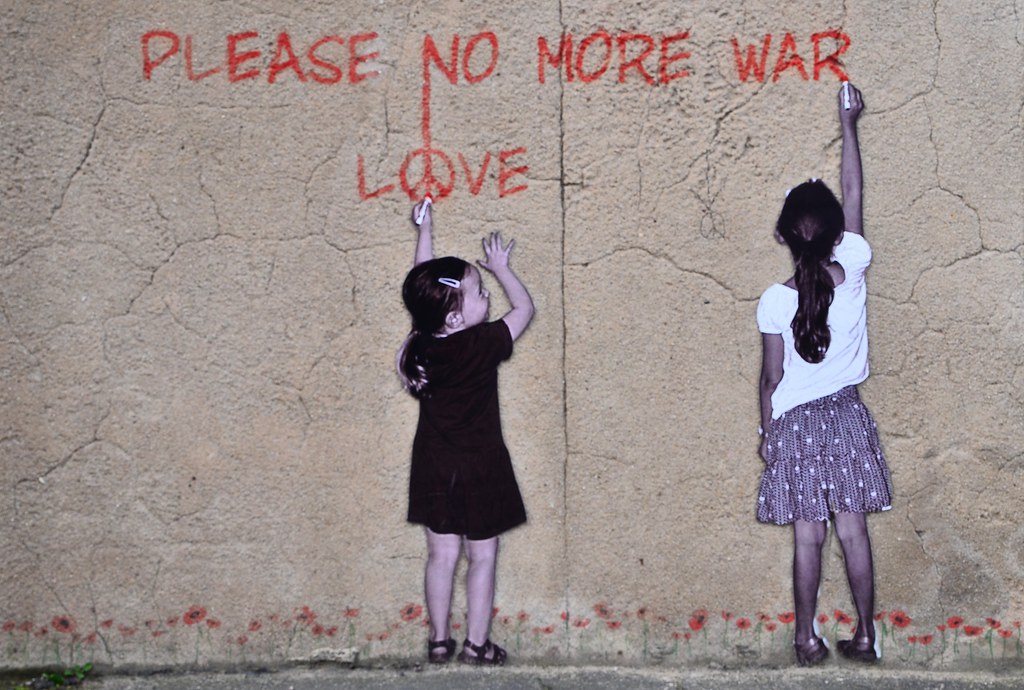
This article applies the concept of remix from media and communication studies to an analysis of the history and transformation of war. From this perspective, each iteration of war can be seen to reference and recombine existing concepts, strategies, and tactics, a process which seems to correspond with the parallel development of technology.