
Human Rights in the Future of Emerging Virtual States

Imagine a futuristic society, where everything is digitalized. Not just work, but meeting friends, traveling, and even the state we live in is now online. Now people are having heated discussions on whether to have their consciousness uploaded onto a cloud service they prefer. Now then, how would statehoods be formed, and who can we define as ‘human’? What changes and challenges would human rights face? As the possibility of more pandemics to come, under the extreme change of climates, this essay ponders over the idea of a fully digitalized future, and a few matters of human rights we need to consider.
Presentación del Centro Global de Innovación para la Paz y del libro “Innovación para la Paz”
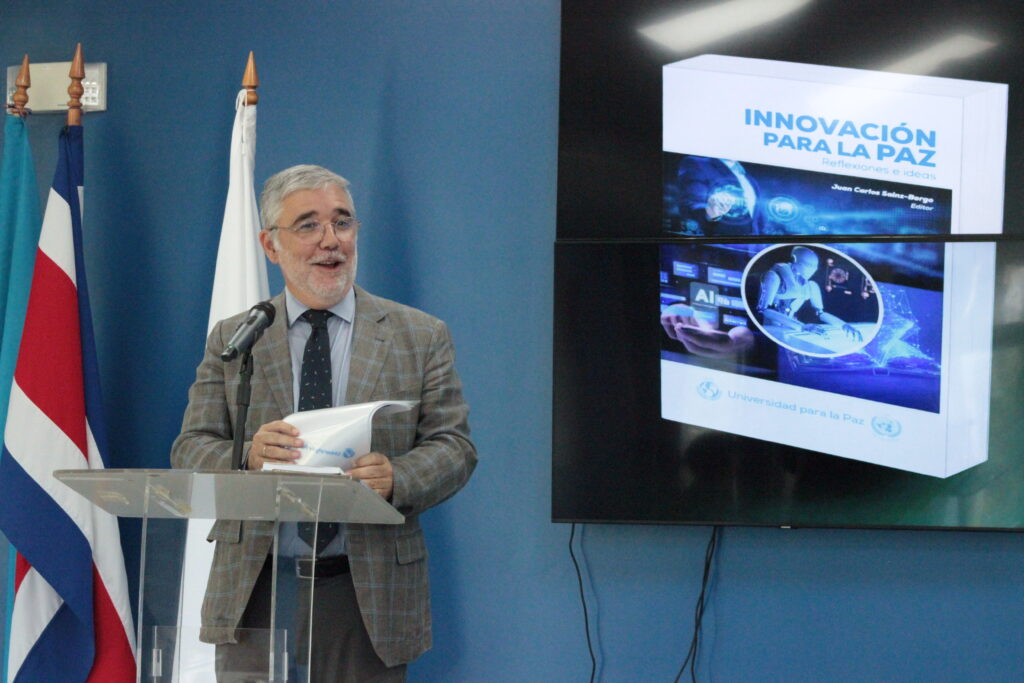
El 1 de abril, la Universidad para la Paz (UPAZ) celebró en su Aula Magna el evento “Innovación para la Paz”, orientado a reflexionar sobre cómo responder a las nuevas realidades en materia de paz mediante la colaboración interdisciplinaria. El Vicerrector, Dr. Juan Carlos Sainz-Borgo, presentó la visión del Centro Global de Innovación para la Paz, creado en 2022 para fomentar un mundo donde paz, innovación y sostenibilidad se sustenten en acción ética y cooperación intercultural. La actividad dio continuidad a los debates que inspiraron el libro Innovación para la Paz. Reflexiones e ideas, presentado en la ONU en 2024, y que en Costa Rica sirvió de base para mesas de discusión sobre áreas prioritarias de innovación (investigación constante, vínculo academia-empresa, capacitación tecnológica y políticas públicas innovadoras), formación de alianzas estratégicas con actores diversos, y exploración de fuentes de financiamiento nacionales e internacionales. Entre los proyectos replicables surgieron laboratorios de innovación tecnológica y programas de microcredenciales. El Rector, Dr. Francisco Rojas Aravena, cerró destacando la importancia de nuevas narrativas para la paz, el arte como medio de expresión pacífica y un desarrollo sostenible centrado en las comunidades.
Child Pornography in the Face of the Technological Revolution

Child Pornography in the Face of the Technological Revolution Author: Denisse María Soto Translated into Spanish by the same author There is increasing access to internet networks and technological devices that are initially designed to improve the quality of life and efficiency of daily activities, through the facilitation of information and communications, creating a global […]
Communication the Pavement to Build Peace

Communication the Pavement to Build Peace Author: Diana Chávez Acosta Conflicts between individuals or groups arise from miscommunication, the way we express things are usually more influential than what we are actually saying. Imagine all the conflicts and inconveniences we could avoid by first expressing ourselves correctly and most of all listening and understanding the […]
Human Rights in AI Facial Recognition

Human Rights in AI Facial Recognition: a look into China’s abuse of AI technology Author: Caroline Adams AI Facial Recognition AI Facial Recognition has become one of the most controversial topics in the digital era. It is a successful tool and measure in biometrical technological advances. However, it has ethical barriers and dangers to human […]
TECNOLOGÍA DE RECONOCIMIENTO FACIAL CON UN ENFOQUE DE DERECHOS HUMANOS

Este artículo considera el impacto de las tecnologías de reconocimiento facial en la protección del derecho a la privacidad
The Power of Appreciative Inquiry

Appreciative Inquiry is an innovative approach to creating deep connections and building bridges with others. While the Artificial Intelligence process feels quite intuitive, it is rarely applied systematically in practice. We will explore The Simultaneity Principle which says that inquiry and change are not truly separate moments but are simultaneous. The moment we ask a question, we begin to create a change.
ICT Governance vs. Community Empowerment: Grassroots Evidence from Bangladesh
Mizanur Rahman analyzes the assertion that Information and Communication Technology (ICT) is the catalyst to enhance community empowerment, reporting on research study, “Community Empowerment through ICTs: Evidence from the Grassroots in Bangladesh and India”. His analysis of evidence from Bangladesh shows that ICT penetration alone is not proportionately related to community empowerment; but rather that ICT penetration combined with the precise application of ICT governance strengthen community empowerment. The evidence also shows that if ICT penetration is high but ICT governance is low, ICT does not remain a high catalytic factor for community empowerment.