
Presentación del Centro Global de Innovación para la Paz y del libro “Innovación para la Paz”
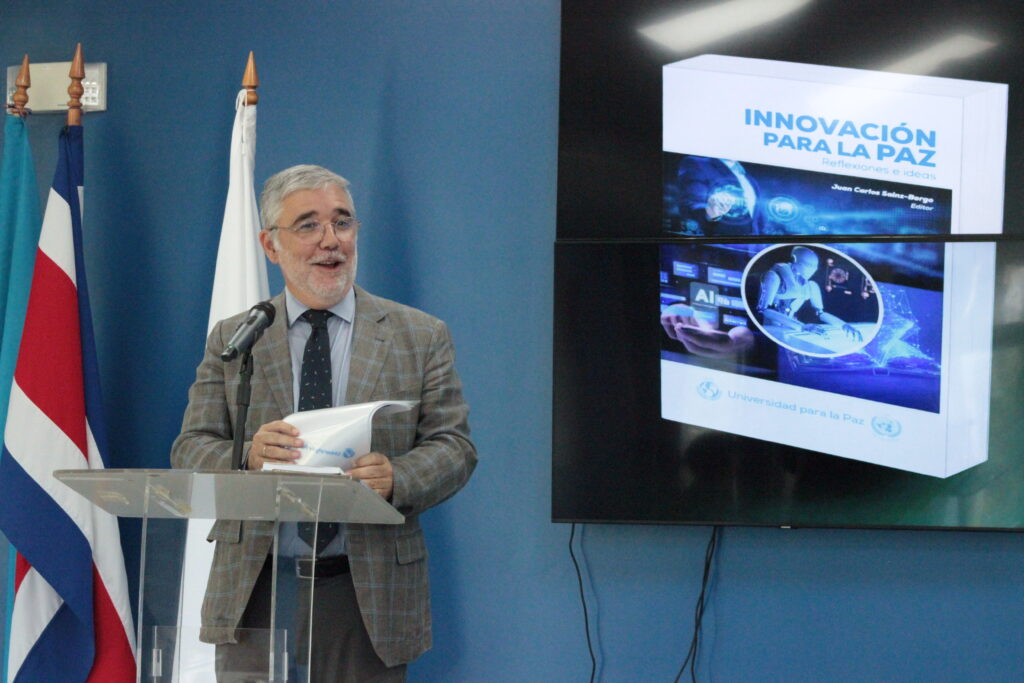
El 1 de abril, la Universidad para la Paz (UPAZ) celebró en su Aula Magna el evento “Innovación para la Paz”, orientado a reflexionar sobre cómo responder a las nuevas realidades en materia de paz mediante la colaboración interdisciplinaria. El Vicerrector, Dr. Juan Carlos Sainz-Borgo, presentó la visión del Centro Global de Innovación para la Paz, creado en 2022 para fomentar un mundo donde paz, innovación y sostenibilidad se sustenten en acción ética y cooperación intercultural. La actividad dio continuidad a los debates que inspiraron el libro Innovación para la Paz. Reflexiones e ideas, presentado en la ONU en 2024, y que en Costa Rica sirvió de base para mesas de discusión sobre áreas prioritarias de innovación (investigación constante, vínculo academia-empresa, capacitación tecnológica y políticas públicas innovadoras), formación de alianzas estratégicas con actores diversos, y exploración de fuentes de financiamiento nacionales e internacionales. Entre los proyectos replicables surgieron laboratorios de innovación tecnológica y programas de microcredenciales. El Rector, Dr. Francisco Rojas Aravena, cerró destacando la importancia de nuevas narrativas para la paz, el arte como medio de expresión pacífica y un desarrollo sostenible centrado en las comunidades.
The evolution of the right to development in international law, from the post-WWII to present times

The right to development emerged from newly independent States and their claim for compensation for the damages caused by colonial rulers
Is Diplomacy Gendered? A Feminist Analysis
Diplomacy is an important arena of International Relations, however it is not always well understood. This paper employs a feminist lens to develop a thoughtful response to the question: is diplomacy gendered? Firstly, I develop an understanding of diplomacy, which is then employed to a discussion of the evolution of the discipline of diplomacy from its origins in traditional state-based diplomacy to regional and multilateral diplomacy. Secondly, l draw upon leading feminists in International Law to develop the paper’s feminist framework for analysis. I then build upon this to discuss the qualities necessary to succeed as a diplomat. It will be shown that diplomacy is the product of a historically and structurally male-dominated patriarchal system. Throughout the paper, I demonstrate that diplomacy is in fact gendered, but with an unfair male preference.
Experiments with Diplomacy: The changing understanding of “real” in Realpolitik
This article traces the history of diplomacy as a history of shifting ideas and values, and also of surprising coherence across time and space, as ancient ideas of political interaction continue to underpin modern diplomatic practices and the emerging structure of 21st century international relations.
China’s Oil Security: Diplomacy, Economics and the Prospects for Peaceful Growth
How does China’s pursuit of oil security drive its foreign policy and its participation in world markets? Analysis by Sigfrido Burgos Cáceres.