
Three Approaches to the Human Security Risk of Climate Change
In this paper, I will construct potential ‘solutions’ to the problem of global climate change within the theoretical frameworks of hegemonic peace, liberal peace, and cosmopolitan peace.
El Salvador’s Election as Conflict Transformation
The victory of a representative of the former guerrilla FMLN movement in El Salvador’s presidential election – the culmination of a process that began with the peace accords in 1992 – is an exemplary case of conflict transformation, says Victor Valle.
This article is cross-posted with the online magazine Open Democracy www.opendemocracy.net
The Politics and Marketing of Transition: Macedonian Parliamentary Elections 2002
JULIJANA MLADENOVSKA analyses the Macedonian elections of 2002, and concludes that few parties went to the people with concrete messages. It would be better for the parties in Macedonia to attempt to meet the real needs of the voters. The Macedonian citizen, regardless of his ethnic background and his/her fears related to the violent conflicts and an uncertain future, is growing to be a serious critic of the groups and individuals leading Macedonian political life. It is time for a more responsible and honest political leadership.
Understanding the 2013 Coup d’état in the Central African Republic
This article explores the political and economic motives behind the March 2013 Coup D’état in the Central Africa Republic, and the formation of the Séléka. This analysis also addresses the many social grievances of the country and looks towards the potential for continued unrest.
The political Crisis of the 2017 Honduran Election
Daniel Bagheri reports on the ongoing tensions in Honduras following the 2017 national elections.
Has Democracy Enhanced Development in Africa?
Whether democracy guarantees development and whether development depends on democracy remain hard to answer questions to any looking outside the continent for inspirations. From the East, we find examples of significant development without the blue prints of modern state democracy or liberal democracy while in the west we find significant contribution of the values of democracy to development endeavors. This article discusses this paradox and suggests that for Africa it is imperative to take the two on board.
The Logic of the Coup
The Logic of the Coup Author: Ajong Mbapndah Laurean Originally published at Peace and Conflict Monitor on 03/15/2006 In loose terms a coup d’etat can be defined as the unconstitutional action of acceding to political power, often with the use of force. The military often uses this method of taking power, and for a long […]
Afghanistan Beyond Bonn: Keep the Champagne Corked
Recent elections in Afghanistan went off without a hitch, but the country – currently with a development ranking of 172 out of 178 – is still very much in the woods. The crime rate is high and poppy cultivation is on the rise. Insurgency violence is growing as well, with 50 US soldiers killed in the first half of 2005, compared to 60 soldiers killed in the first three years following the 2001 invasion. Even as the newness of the Afghan mission fades, the international community should dig in: There’ve a long way to go yet.
It’s not over. Reports that Afghanistan is at peace, articles on the “establishment of democracy” are everywhere in western media. However these claims, too often made by journalists ‘in the field’ just long enough to get the dateline for big events like the recent elections, must be read in the context of a continually emerging state of civil war.
The Bonn conference in December 2001 after the collapse of Taliban rule envisaged, “the establishment of a broad-based, gender-sensitive, multi-ethnic and fully representative government”, which has in theory taken place. The most important aim of that same conference, though, was the establishment of peace and security in the country. Yet the elements of war still exist, and only the presence of ISAF (International Security Assistance Force) has prevented possible civil war. Democracy has arrived in Afghanistan only in name. The reality is much messier, particularly in the south and east.
Uganda Needs its Human Rights Commission!
Some elements of the Ugandan Government want to abolish the Human Rights Commission. The Commission, argues, Ferdinand Katendeko, is vital for the health of the Ugandan Democracy.
Under the Guise of Protecting Human Rights and Establishing Democracy: US Intervention in Sri Lanka
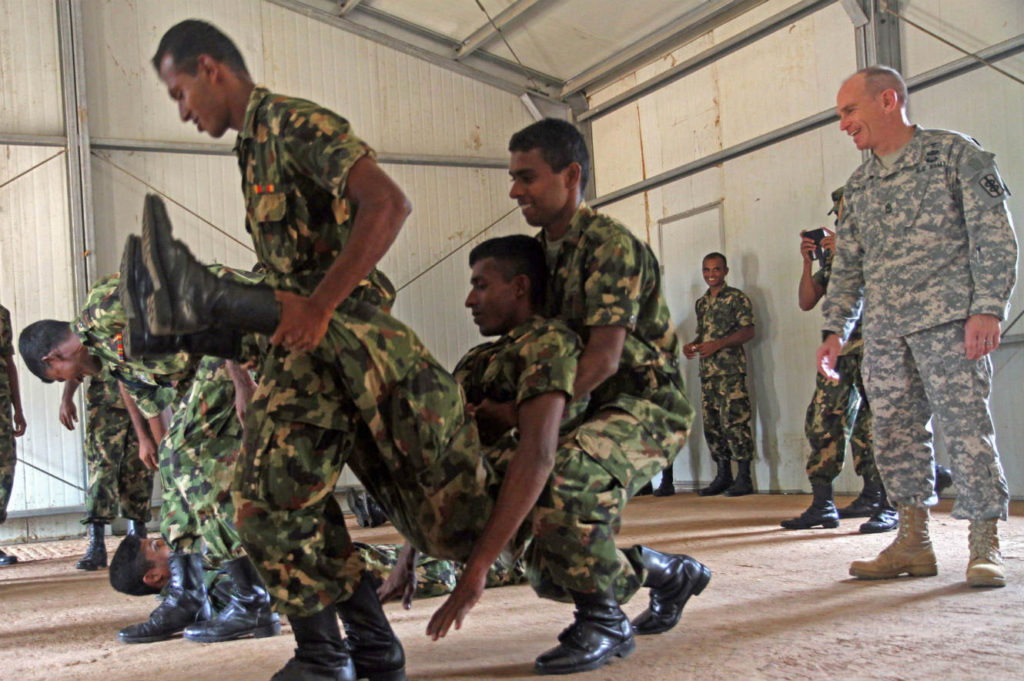
The paper argues that strong US intervention in Sri Lanka after the end of the island’s armed conflict in 2009 is not based on altruistic efforts to protect human rights as presented in mainstream sources, but stems from deepening US geopolitical and ideological interests in the Indian Ocean region. Keywords: Sri Lanka-US relations, US foreign policy, North-South relations, Neoliberal policy, interventionism, Indian Ocean, US-China relations