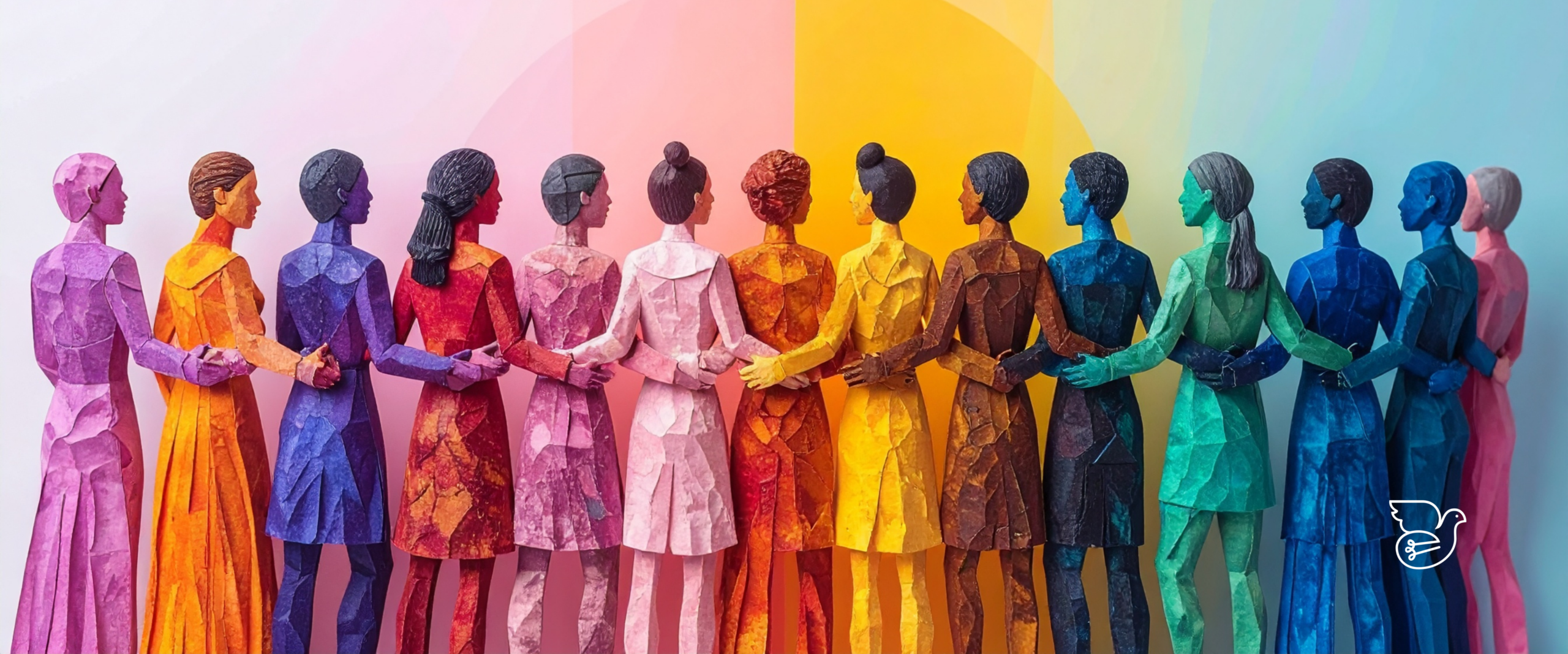
Founding Sisters
Autor: Carol Peasley
Originally Published at Peace and Conflict Monitor on: 03/16/2009
As we celebrate International Women’s Day
War and Women’s
History Month throughout March, we need to remember that the origins of
these events go back to long-ago protests in Europe and the United States for
the political rights of working women. Those political roots are important,
especially for those of us who care about history and want to learn from the
past. Certainly, in the United States, our public media has been filled with
recent celebrations of our history, including remarkable insights about Abraham
Lincoln on the 200th anniversary of his birth and about John (and Abigail)
Adams during the brilliantly produced HBO television series. They
certainly provoked me to go back to my history books and to read more about the
founders of the United States. One of my favorites was “Founding
Brothers” by Joseph Ellis. That book was a wonderful reminder of how
fortunate the United States was to have such exceptional founders – people who
put community and nation first, people who knew how to compromise, and people
who had the highest standards of integrity.
Now, why would the CEO of an
organization known for training and empowering women promote a book titled
“Founding Brothers”? The answer is simple: I hope future generations around the
world will be reading about the “founding sisters” in their countries.
There are many women around the globe
who are writing the initial chapters of those books. While most are unseen by
the elites in their countries, these grassroots activists are providing
services and pushing for reforms in their countries. These “sisters” abound
with the unique characteristics of those founding brothers in 18th century
America – i.e., intelligence, integrity, commitment, collegiality, energy, the
ability to compromise and a willingness to sacrifice for the larger whole.
The challenge for all of us, as we
celebrate women this month, is to find new ways to expand the voices and
profiles of these women. Certainly we at CEDPA, and those in our sister
organizations around the world, are committed to helping a new generation of
women leaders emerge so that they can become their country’s “founding
sisters.” We want them to emulate women like CEDPA board member, Phoebe M. Asiyo, a
former commissioner of the Constitution
of Kenya Review Commission and current chair of Kenya’s Caucus for Women’s Leadership.
Phoebe has had a remarkable impact in Kenya and on all of us who have had the
honor to work with her at CEDPA. What are some of the steps we need to take to
help build more “Phoebes”?
- We need to strengthen
women’s leadership
training around the world and do it the right way. Only highly
motivated participants who are committed to replicating their training
should be selected; trainees should be challenged to develop and then
implement action plans to apply their training; and they must have the
chance to learn from one another and to network with others. When done
right, the results can
be remarkable. - We need to build
coalitions of individuals and organizations that can advocate for
change and achieve concrete goals. Such coalitions can have substantial
impact, as reflected by CEDPA’s experience
with women’s advocacy networks in Egyptian governorates. Those networks
led to thousands of new female registered voters, health improvements and
new microenterprise opportunities. - We need to mobilize
women voters and ensure that women participate in all aspects of the
electoral process: as candidates, activists, poll workers and election
monitors as well as voters. Again, CEDPA has seen first-hand the important
role women’s groups can play in fledgling democracies such as Nigeria over
the past ten years. Five Nigerian women’s coalitions launched voter
education activities in 1998 and mobilized more than 750,000 new
registrants for the country’s critically important 1999 election. In later
years, these coalitions took on even broader roles, moving beyond voter
education to active roles in monitoring election posts and in securing
greater confidence in the democratic process. - We need to elect
more women candidates. Women hold less than 20 percent of all
parliamentary seats worldwide and are underrepresented in other community
and national decision-making bodies, thus limiting their influence on the
policies and resources that govern their daily lives. - We need to
hold public officials accountable. Some successful strategies have
included the formation of local advocacy groups; the collection of data
and monitoring by “watchdog” groups; use of report cards for public
officials; and work with journalists. When local groups are persistent and
when they take the time to adequately document government performance,
they can bring about change. Certainly we saw this in Kaolack,
Senegal where community activists convincingly pointed out government
shortfalls and thus increased the funding for reproductive health,
including the free provision of medical kits for delivery and caesarean
births. - We need to advance
peace and security. When countries emerge from conflict, a window of
opportunity opens to advance women’s leadership, foster democratic systems
and create new policy frameworks, governing structures and institutions.
We need to ensure that women are represented at all stages of the process
of securing and maintaining peace, whether in mobilizing communities to
end hostilities; providing support to victims; strengthening community
institutions that bring people together; serving as military observers;
designing and implementing demobilization plans; training the security
forces to address gender-based violence; or leading and participating in
political processes to develop new governing structures. We have certainly
seen the success of this approach through our work with the WomenAct
coalition, a group that has ensured active female participation in Nepal’s
constituent assembly and constitution-writing process.
As we move forward on all of these
steps, we can be sure that we are paving the way for that next generation of
“founding sisters.” I can hardly wait to read that book.
Bio: Carol Peasley is president of the centre for development and population activities (CEDPA)