
Post Conflict Restructuring: Syrian Women Refugees
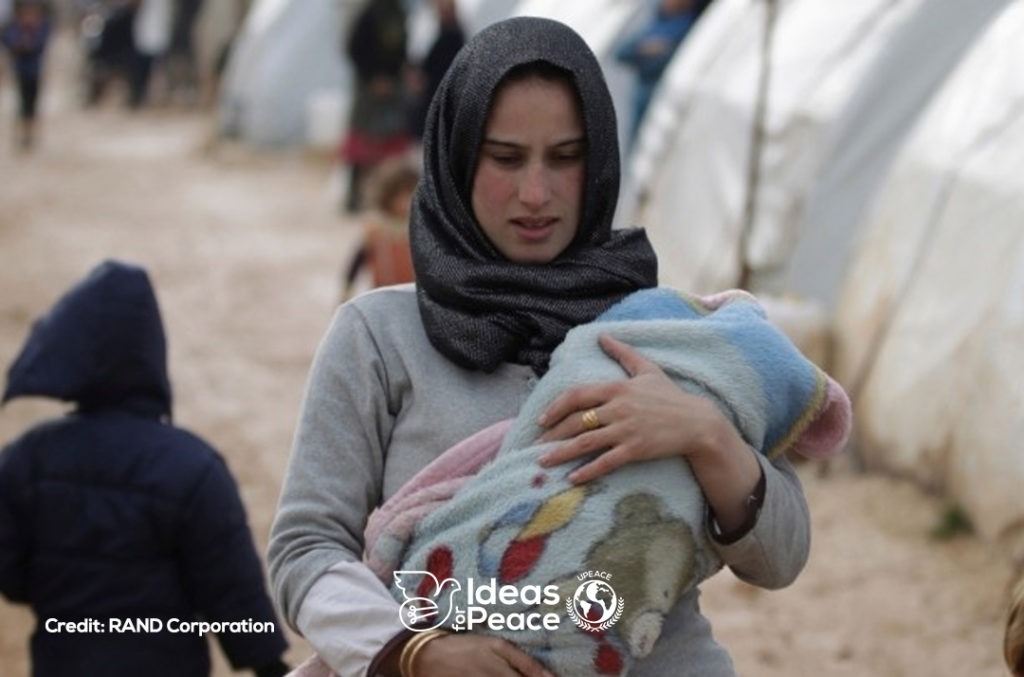
The end of the war in Syria does not signify peace for the refugees. The need of the moment is for the international community to focus on post-conflict restructuring and the holistic economic, social, and political development of the Syrian refugees.
Oily Iraq
The elections in Iraq were widely hailed as a tentative success in an otherwise disastrous situation. But considering the history of foreign intervention in the Middle East when it comes to oil interests, perhaps this silver cloud has a dark lining.
Malala and the Children of Syria
Jahan Zeb writes us about Malala and her father, Ziauddin Yousofzai, who recently visited the Syrian-Jordanian border to meet with people fleeing the conflict in Syria, and to draw international attention to the needs of refugees — especially refugee children.
News from Syria
News from Syria Author: Harout Akdedian Originally Published at Peace and Conflict Monitor on: 08/05/2011 On the 4th of July, on my way to Syria, I was reading a book entitled Between Equal Rights by China Miéville. The book was a Marxian perspective on international law and the title was borrowed from Marx’s famous […]
Causes and catalysts of the civil war in Syria
The causes and catalysts of the current civil war in Syria are many and varied, including narratives that range across religion, poverty, past repression, and ideology. Understanding why the conflict began is only possible when these causes are considered together as a holistic whole rather than as stand-alone explanations. However, this is not to deny that some causes and catalysts have been more significant than others. Whilst early triumphs of civil society movements in Tunisia and Egypt greatly helped to catalyse opposition to the government in Syria, they only serve to mask the critical and much more important underlying change in the social dynamic created by the ideological drift of the Ba’ath Party. Under Bashar al-Assad’s Presidency, the Ba’ath Party increasingly disengaged and decoupled itself from its original political constituency, creating a broad and deep-seated disillusionment with the government within Syrian society. It is this schism that can be identified as the greatest of the causes of the current conflict.
Syria’s Civil War: Regional and International Implications
Jehun Alexander Hong discusses the continued escalation of the Syrian civil war in terms of internal, regional, and international power struggles, in the overlapping sectors of ethnic, religious, political, and economic rivalry. Emphasis is placed on the question of chemical weapons and the high number of child casualties, as well as the impacts of the conflict on neighbouring countries, in terms of displaced persons and wider conflict.
Syria, Iran, and Israel: tensions and potential consequences
Independent journalist Atkilt Geleta comments on the UNGA speeches made by Ahmadinejad and Netanyahu and offers some analytical insight on the worsening Syrian crisis and the complex geopolitical structure of alliances and interests that surround it.
Three Challenges to Peace in Lebanon
Vanessa Bassil argues that social divisions and state failures pose significant, but surmountable challenges to peace in Lebanon.
Unheard Voices from Syria and the Middle East
University for Peace PhD Candidate Harout Akdedian presents grassroots perspectives on the Syrian crisis and an analysis of today’s socio-political reality in the Middle East.
Arabic Awakening: Human Dignity and Democracy in Question
A new order is taking shape from North Africa to the Middle East; but as the dust settles down, will the quest for human dignity and democracy continue? Patrick Mugo Mugo analyzes what kind of governance system will win the hearts and minds of millions of the Arabic people: a Western based concept, or Turkish, Korean, Bangladesh or Indonesian models?