
Presentación del Centro Global de Innovación para la Paz y del libro “Innovación para la Paz”
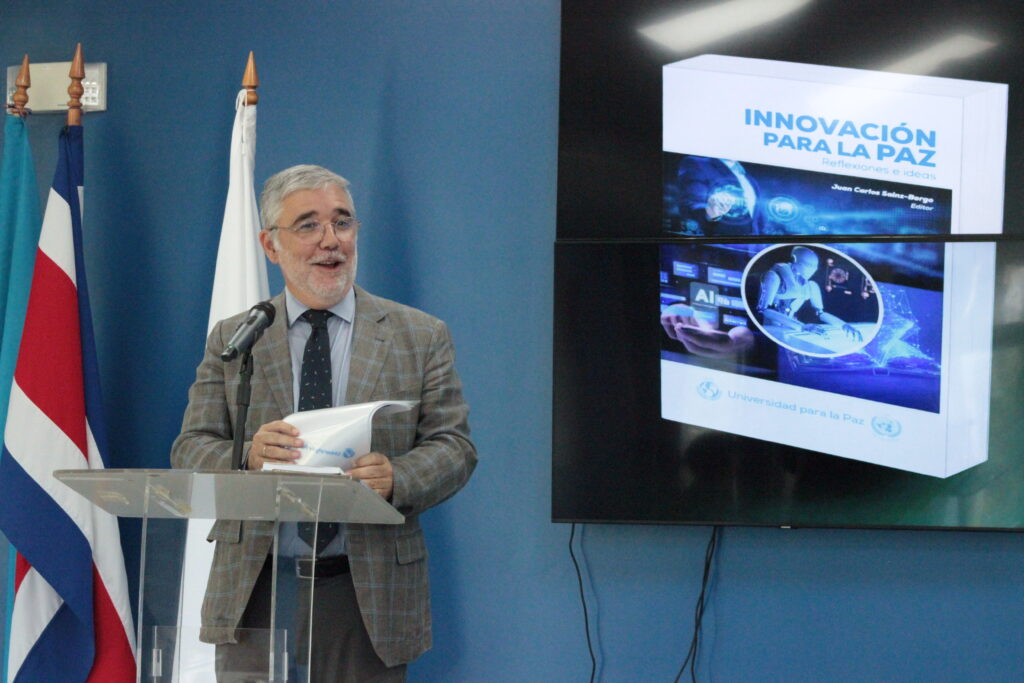
El 1 de abril, la Universidad para la Paz (UPAZ) celebró en su Aula Magna el evento “Innovación para la Paz”, orientado a reflexionar sobre cómo responder a las nuevas realidades en materia de paz mediante la colaboración interdisciplinaria. El Vicerrector, Dr. Juan Carlos Sainz-Borgo, presentó la visión del Centro Global de Innovación para la Paz, creado en 2022 para fomentar un mundo donde paz, innovación y sostenibilidad se sustenten en acción ética y cooperación intercultural. La actividad dio continuidad a los debates que inspiraron el libro Innovación para la Paz. Reflexiones e ideas, presentado en la ONU en 2024, y que en Costa Rica sirvió de base para mesas de discusión sobre áreas prioritarias de innovación (investigación constante, vínculo academia-empresa, capacitación tecnológica y políticas públicas innovadoras), formación de alianzas estratégicas con actores diversos, y exploración de fuentes de financiamiento nacionales e internacionales. Entre los proyectos replicables surgieron laboratorios de innovación tecnológica y programas de microcredenciales. El Rector, Dr. Francisco Rojas Aravena, cerró destacando la importancia de nuevas narrativas para la paz, el arte como medio de expresión pacífica y un desarrollo sostenible centrado en las comunidades.
Cosmologisms?
John Keane, Global Civil Society, Cambridge University Press, 2003, www.cambridge.org ,ISBN 0 521 89462 X paperback pp.220
Global Witness
Joe Schumacher is in conversation with Erin Wakes and Gavin Heyman of Global Witness, a London and New York based NGO concerned with the ethical use of natural resources, particularly in the extractive industries. Much of their work focuses on highlighting corruption and promoting transparency in accounting practises.
Much of the discussion reveals a success story: the Extractive Industries Transparency Initiative. For the work of Global Witness see http://www.globalwitness.org/
Oil, Aids and Africa
This unprecedented oil rush dwarfs the Western aid, Africa currently relies on and provides a unique opportunity to turn the continent around.
However the fear, of many of those who work in promoting sustainable development in Africa, is that this oil bonanza will never benefit the vast majority of Africans, who live in the worst poverty, and will plunge the continent further into chaos
If I had got married, I’d be dead today.
Better late – then never. A couple days after our official start at UPEACE (University for Peace), we noticed another colorful shirt and a new face of a tall strong man. As for many other African students the trip to UPEACE, was anything but easy. Sam’s journey included five stopovers, two countries in Africa, two in Europe and one in Venezuela before finally arriving in Costa Rica. Yes, many of us take the one-day trip and many other things for granted.
Nevertheless, Sam luckily made it.
Georgia-South Ossetia-Russia: Proposals for Immediate Steps to be taken to End Hostilities and Address Humanitarian Impacts
Kai Brand-Jacobson outines some recommendations for various actors and interest groups, including the Joint Control Commission, the EU, the US, the UN, and the Media. Rather than escalating and intensifying this conflict, these groups must realize that a peaceful resolution and a return to dialogue is in everyone’s best interest.
Challenges to Women’s Full Participation in Cambodian Society
In Cambodia, women make important and tangible contributions to the social, political, and economic development of the country. However, like many other parts of the world, such contributions are largely unacknowledged and are not given adequate attention, and Cambodian women are often under-represented, which leads to their passive participation and insufficient empowerment in the community and society at large.
Accordingly, this article touches upon four key challenges to Cambodian women’s participation in social, political, and economic affairs, including: (1) deep-rooted tradition, cultural stereotypes, and social attitudes; (2) gender-biased media and stereotype of Khmer literature; (3) poverty; and (4) high illiteracy. These challenges indicate the reasons why there is lack of women’s dynamic involvement in all affairs, which hinders the development of democratic governance and peace-building in the nation. Effective recommendations, dealing with the challenges, are highlighted before the article comes to a conclusion.
Paul Martin on Human Rights – Interview
Joe Schumacher interviews J. Paul Martin, executive director of the Center for the Study of Human Rights at Columbia University, New York Dr. Martin, together with Professor Louis Henkin (University Professor Emeritus/Special Service Professor, Columbia University), founded the Center in 1978, and has served as its executive director ever since. Dr. Martin spent several years as a missionary and university teacher in Africa, and over the years, Dr. Martin’s primary research interest has been human rights education, especially in Africa, as well as religion and human rights. Currently his work is focused on the impact of multinational corporations on developing countries from a human rights perspective.
Self-immolation in Tajikistan
A significantly large number of young women in Tajikistan, and elsewhere in Central Asia, forced into marriage attempt suicide by setting themselves alight. The author explains why.
Sport as an International Tool for Development and Peacebuilding
Satomi Tsuchiya argues for the greater use of sport in peace and development work, with reference to the great potential of sport to engage youth especially — of both genders — in positive social activities that build trust and community.