
Rethinking the Administration and Delivery of Foreign Aid in Cambodia
The government of Cambodia has received foreign development aid in abundance for many years, largely contributed by a number of international aid organizations and donor states such as World Bank, Asian Development Bank, International Monetary Fund, Official Development Assistance (ODA), and Japanese as well as Chinese governments.
Unfortunately, this aid has not served as a constructive engine to promote economic growth and development, and has not provided tangible benefits for the targeted population, the poor and the vulnerable, in the country.
This article, therefore, presents some specific reasons for the poor management and ineffective delivery of foreign aid in the nation, and offers some viable and practical mechanisms of how foreign aid should be properly administered and distributed in Cambodian society.
Disarmament, Demobilization and Reintegration of Ex-Combatants in Conflict Affected Northern Uganda
This paper shall apply a discourse analysis of Disarmament, Resettlement and Reintegration (DRR) of ex-combatants with special emphasis on Northern Uganda, a region which has faced conflicts for over two decades. I apply knowledge and skills required to plan, manage and implement programmes for sustainable recovery of war-torn Northern Uganda. The paper will showcase skills in rehabilitation, reconstruction, peacebuilding and the role of civil society. My prior engagement in a post-conflict recovery human rights project in Uganda, as well as my experiences supporting DRR under the Amnesty Commission, will be used to address the topic from a practical point of view. The paper includes a general overview, key actors in the conflict, DRR in detail, Sexual Gender Based Violence (SGBV) issues, DRR challenges, appropriate responses or recommendations and conclusion. I believe this study will also empower me to effectively and efficiently serve in conflict management, peacekeeping and peacebuilding foras.
Key words= ex-combatants, disarmament, demobilization, reintegration
International Cooperation to Control the Intergovernmental Small Arms Trade: Case Study China-Sudan
After outlining the deadly scope of today’s small arms trade, this paper touches on questions of international law and responsibility, or lack thereof, as illustrated by the legal intergovernmental transfer of arms from China to the Sudan, despite international pressure urging the contrary. References include United Nations documents, task force and international NGO campaign reports, contemporary media coverage and University for Peace lecture discussions.
Nepal’s recovery process since the 2015 earthquake
Tags: Nepal, Earthquake, Disaster Risk Reduction, National Reconstruction Authority (NRA), Hyogo Framework, Resilience, Preparedness
Women’s Political Representation in Sri Lanka: Leading towards Prosperity or Peril
This paper argues that greater representation of women in Sri Lanka’s parliament and local government institutions, and greater gender sensitivity in general, will have substantially positive implications for the country, including accelerating the post-conflict reconciliation and recovery process.
Cuban-European NGO Collaboration: The ‘Special Period’
The purpose of this article is to achieve an understanding of the nature of nongovernmental organisations (NGOs) in Cuba and to highlight aspects of the collaboration that has occurred between Cuban and European NGOs. The motivation for undertaking this study is to begin the process of filling the gap in information with respect to Cuba’s NGO community and to get a sense of the circumstances under which international cooperation is carried out on the island. This article constitutes the preliminary findings of an interdisciplinary study of the role of NGOs operating within the context of a revolutionary socialist society. The article begins with essential background to understanding the reasons European NGOs entered Cuba in the 1990s
Evangelicals Invade Iraq
United States based evangelical NGOs and evangelical churches alike mobilized their forces to distribute humanitarian aid, as well as a plethora of Christian literature and an army of missionaries. As the efforts were underway, the onlooking Muslim world suspiciously questioned such motive
Under the Guise of Protecting Human Rights and Establishing Democracy: US Intervention in Sri Lanka
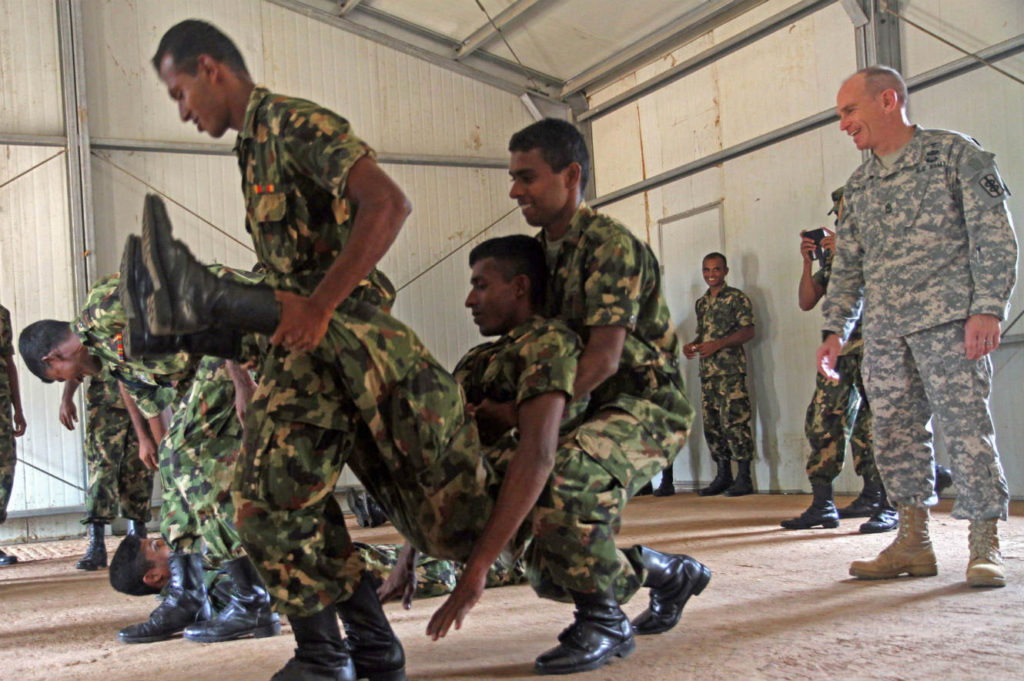
The paper argues that strong US intervention in Sri Lanka after the end of the island’s armed conflict in 2009 is not based on altruistic efforts to protect human rights as presented in mainstream sources, but stems from deepening US geopolitical and ideological interests in the Indian Ocean region. Keywords: Sri Lanka-US relations, US foreign policy, North-South relations, Neoliberal policy, interventionism, Indian Ocean, US-China relations