
Breeding Trouble
In a world where many people expect progress with each generation, most of the young Central Asia are worse off than their parents. They have higher rates of illiteracy, unemployment, poor health, and drug use, and they are more likely to be victims and perpetrators of violence. The Central Asian states need to confront grim realities in education and labour opportunities if they are to turn the next generation away from socially destructive alternatives.
India’s Development Diplomacy: Re-Engaging Afghanistan
The present approach of engaging regional players in Afghanistan by the United States could be scuttled by the bargaining postures of Iran, Russia, Pakistan, India and China on various issues of mutual concern. Rather than overtly depending on United States for guiding India through its AfPak strategy, India needs to proactively engage regional players- Iran, Russia and China through pro-active diplomacy, which could lead to potential joint problem solving initiatives. Also Indian initiatives could help defining issues in Afghanistan more in terms of creating value and bringing stability and security for all the concerned state parties.
Self-immolation in Tajikistan
A significantly large number of young women in Tajikistan, and elsewhere in Central Asia, forced into marriage attempt suicide by setting themselves alight. The author explains why.
The Orange Revolution
Some doubted that the opposition could pull off the so-called “Orange Revolution” in the Ukraine. But with the elections complete and the dust clearing, pro-democracy reformer Viktor Yushchenko sits in the presidency. Here Suleymanov explores what went right for the opposition, what went wrong for the establishment, and why Russian influence just wasn’t strong enough.
Chatting about Peace
An interview conducted by Vicky Rossi with Ms Julia Marton-Lefèvre, Rector of the University for Peace, and Prof. Abelardo Brenes who is Head of the Peace Education Programme, University for Peace. The interview originally appeared on the Transnational Foundation for Peace and Future Research website, and was conducted via e-mail.
India as Superpower?
India’s quest for security appears to be expanding beyond her own borders on a global scale. Can it be regarded as a welcome prospective trend? India’s upcoming military base in Central Asia may as well be an exercise in sharing United States security concerns around the world. Beginning is apparently being made at oil rich Tajikistan. Is India looking forward to be a superpower in another decade’s time? Is India changing her policy of peaceful co-existence? All these are pointers worth considering. India is already playing a predominant role in the South Asian context. Where will this new road to security end for India?
Charlie Wilson’s War
Author George Crile published Charlie Wilson’s War in 2003. The former CBS journalist began researching the U.S. involvement in Afghanistan around the 1980’s. Crile investigated the life and work of Charlie Wilson, a former U.S. State Representative from Texas and former U.S. naval officer. Wilson is most known for leading “Operation Cyclone,” a CIA operation which allegedly led to the creation of the Afghan Mujahidin groups.
In a PCM interview with University for Peace Rector John Maresca, Charlie Wilson’s War was a highly recommended resource for understanding the fragile state of Afghanistan.
Role of History in the Creation of National Identities in Central Asia: Uzbekistan and Kyrgyzstan Case Studies
Muzaffar Suleymanov explores the uses and abuses of history teaching in two Central Asian Republics. Tamurlane and the mythical figure of Manas are being used, it is argued, in Uzbekistan and Kyrgyzstan, to help build nation states regardless of the real histories of the region.
The Role of Identity in Georgia s Security Policies: Critique of Realism
The BBC reports (May 5, 2004) that the “Georgian leader Mikhail Saakashvili has imposed direct presidential rule in the rebel region of Ajaria. The moves came amid growing pressure on Ajaria’s leader Aslan Abashidze to accept Tbilisi’s authority or resign. The Georgian government has warned Aslan Abashidze that he has only a few hours to step down and avoid bloodshed.” We offer Vahagn Muradyan’s article on the problems of identity in Georgia in explaining its Security Policies.
Under the Guise of Protecting Human Rights and Establishing Democracy: US Intervention in Sri Lanka
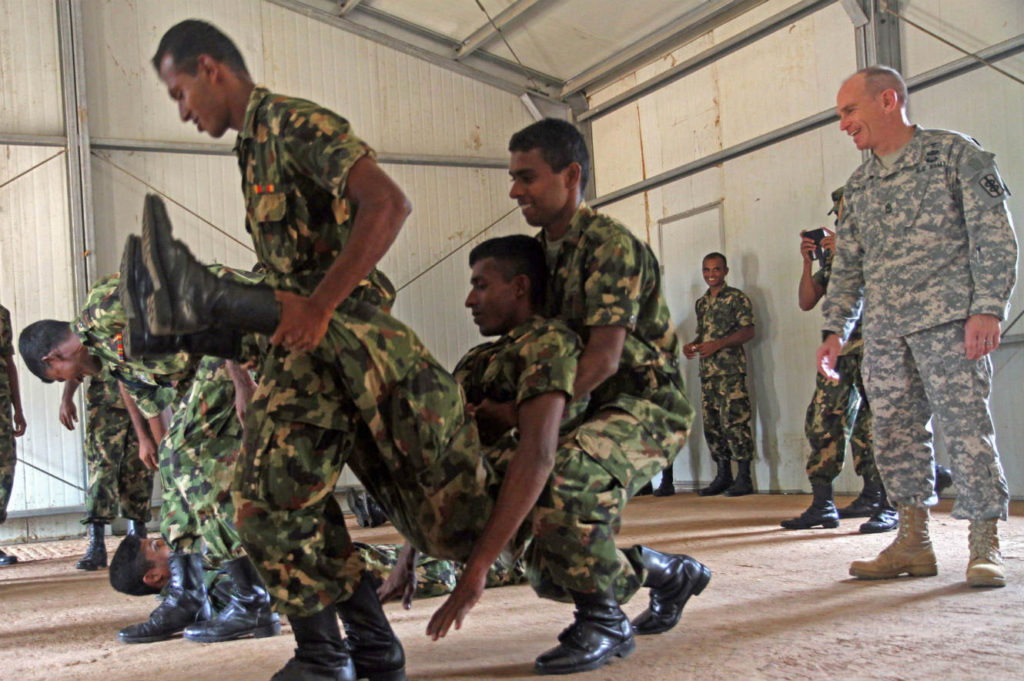
The paper argues that strong US intervention in Sri Lanka after the end of the island’s armed conflict in 2009 is not based on altruistic efforts to protect human rights as presented in mainstream sources, but stems from deepening US geopolitical and ideological interests in the Indian Ocean region. Keywords: Sri Lanka-US relations, US foreign policy, North-South relations, Neoliberal policy, interventionism, Indian Ocean, US-China relations