
Managed Retreat or Forced Displacement? Conservation and Conflict in the Sundarbans
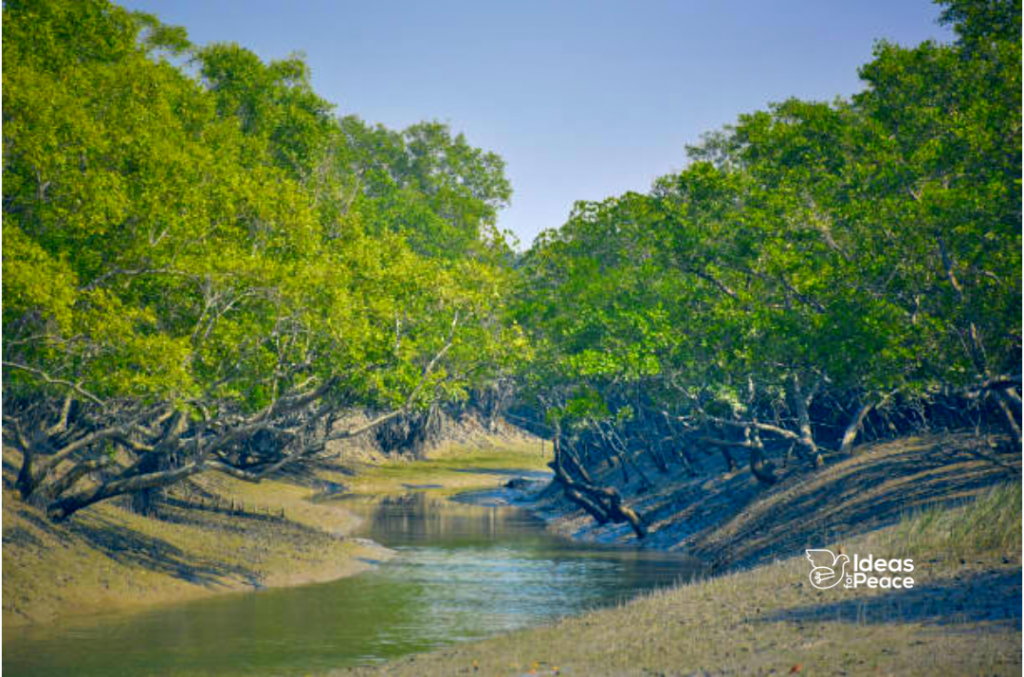
Managed Retreat or Forced Displacement? Conservation and Conflict in the Sundarbans Author: Sara-Duana Meyer The world’s largest riverine mangrove forest grows along the border of Southern West Bengal in India and Eastern Bangladesh. The Sundarbans,[1] literally beautiful forest, are of global importance as a natural carbon sink, a vital ecological buffer zone for the river […]
Climate Change induced Disasters and Gender Dimensions: Perspective Bangladesh
This paper attempts to focus on the theoretical aspect of gender and climate change. In addition, the paper looks into how specific gender characteristics increase women’s vulnerability and how the effects of climate change affect women more severely than men. This paper will, finally, look into policies to face the challenges and mainstream gender perspectives.
The First Refugees of Global Warming
“Where we are standing, in five days it will be gone,” foresees a rural Bangladeshi. Rivers will swallow additional land this monsoon season forcing more and more people to find refuge in Dhaka. Where was once rice farms is now shrimp farms; where was once villages is now submerged. Climate change takes its toll in Bangladesh without lament.
ICT Governance vs. Community Empowerment: Grassroots Evidence from Bangladesh
Mizanur Rahman analyzes the assertion that Information and Communication Technology (ICT) is the catalyst to enhance community empowerment, reporting on research study, “Community Empowerment through ICTs: Evidence from the Grassroots in Bangladesh and India”. His analysis of evidence from Bangladesh shows that ICT penetration alone is not proportionately related to community empowerment; but rather that ICT penetration combined with the precise application of ICT governance strengthen community empowerment. The evidence also shows that if ICT penetration is high but ICT governance is low, ICT does not remain a high catalytic factor for community empowerment.
Social Business: Challenging the Traditional Way to Do Business
UPeace Professor Nika Salvetti draws attention to new approaches in business that strive to diversify the profit-seeking priorities of the business world toward more sustainable and socially responsible practices. She highlights the contribution of Nobel Peace Prize Laureate Muhammad Yunus, whose prescriptions for social business include sustainability, improved working standards, reinvestment of profits within the business itself, and poverty reduction as a business objective.
Climate Change, Sea Level Rise and Conflict Resolution of South Talpatti/New Moore Island
What happens when rising sea levels submerge an island at the center of an international territorial dispute? Ishak Mia argues that it may lead to conflict resolution.
Arabic Awakening: Human Dignity and Democracy in Question
A new order is taking shape from North Africa to the Middle East; but as the dust settles down, will the quest for human dignity and democracy continue? Patrick Mugo Mugo analyzes what kind of governance system will win the hearts and minds of millions of the Arabic people: a Western based concept, or Turkish, Korean, Bangladesh or Indonesian models?
Mutiny and Media in Bangladesh
Suriya Urmi analyzes the 2009 mutiny of Bangladeshi border guards (BDR) against army officers. This article specifically focuses on the media´s role, as BDR soldiers successfully deceived public opinion before the atrocities were discovered.
Fire, Water, Earth: The Kashmir region
The India-Pakistan conflict has seen much progress toward resolution in the last years, with bilateral cricket matches taking place and buses now passing to the Kashmir region. Yet tension in the form of arms shopping and multiple missile tests still persists. Through analyzing the three aspects of the conflict – fire, water, and earth – Semu Bhatt proposes some tentative solutions.