
Presentación del Centro Global de Innovación para la Paz y del libro “Innovación para la Paz”
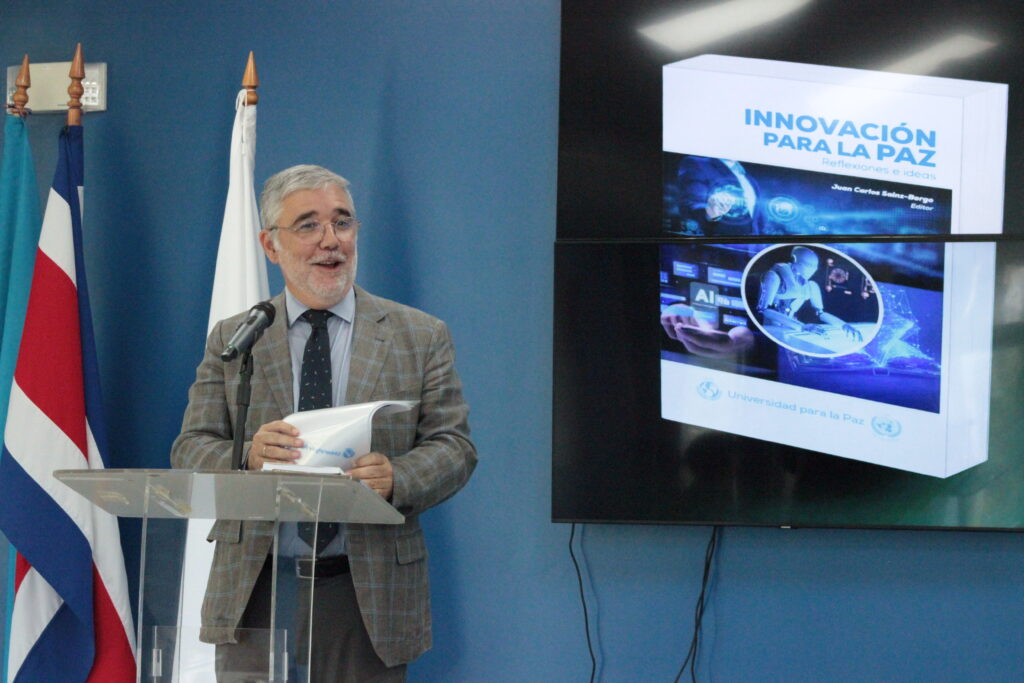
El 1 de abril, la Universidad para la Paz (UPAZ) celebró en su Aula Magna el evento “Innovación para la Paz”, orientado a reflexionar sobre cómo responder a las nuevas realidades en materia de paz mediante la colaboración interdisciplinaria. El Vicerrector, Dr. Juan Carlos Sainz-Borgo, presentó la visión del Centro Global de Innovación para la Paz, creado en 2022 para fomentar un mundo donde paz, innovación y sostenibilidad se sustenten en acción ética y cooperación intercultural. La actividad dio continuidad a los debates que inspiraron el libro Innovación para la Paz. Reflexiones e ideas, presentado en la ONU en 2024, y que en Costa Rica sirvió de base para mesas de discusión sobre áreas prioritarias de innovación (investigación constante, vínculo academia-empresa, capacitación tecnológica y políticas públicas innovadoras), formación de alianzas estratégicas con actores diversos, y exploración de fuentes de financiamiento nacionales e internacionales. Entre los proyectos replicables surgieron laboratorios de innovación tecnológica y programas de microcredenciales. El Rector, Dr. Francisco Rojas Aravena, cerró destacando la importancia de nuevas narrativas para la paz, el arte como medio de expresión pacífica y un desarrollo sostenible centrado en las comunidades.
Fighting for a New Culture

Fighting for a New Culture. How Activism is Needed to Gain Peace in the Fight Against Sexual Violence Author: Kolfinna Tómasdóttir Translated into Spanish by Ana Elena Acon “Never doubt that a small group of thoughtful committed citizens can change the world; indeed, it is the only thing that ever has.” Margaret Mead In May […]
Entrevista con Dra. Manuela Mesa

Entrevista con Dra. Manuela Mesa En esta edición de Ideas for Peace, te presentamos la entrevista que hicimos con la doctora Manuela Mesa en 2019. La Prof. Mesa es Co-Directora del Instituto Universitario sobre Derechos Humanos, Democracia, Cultura de Paz y no violencia (DEMOSPAZ) en la Universidad Autónoma de Madrid. También es la Directora del […]
Challenging US War Myths
About the book: When many Americans hear that the US may go to war against another nation, they tend to believe there’s probably a good reason for it or that no viable alternatives exist—or they don’t think about it at all. They trust their leaders to represent them and defend their values. They accept their leaders’ claims that war is to ensure their safety when others wish to harm them.The parties of war play on Americans’ basic values to bring them online. The media reassures them that the reasons for war are altruistic— that Americans wish to spread democracy and allow others to adopt their way of life. But is this the case?
With 24 compelling illustrations, maps and graphs, this book is intended to serve as a tool for peace advocacy. Well known peace advocates respond to 19 of the most common illusions held by the American public which weaken their opposition to Washington’s wars.
Malala and the Children of Syria
Jahan Zeb writes us about Malala and her father, Ziauddin Yousofzai, who recently visited the Syrian-Jordanian border to meet with people fleeing the conflict in Syria, and to draw international attention to the needs of refugees — especially refugee children.
Bono Promotes Trip Down Memory Lane
The purpose of a corporation is to make money. So who is really going to benefit from Bono’s much-hyped Product Red?
John Lennon’s Political Lyrics in Popular Culture: From Resistance and Activism To Incorporation and Commodification
Aside from music being used a tool for personal expression, it also has the potential to influence social and political cultures. John Lennon, musician and social activist, has proven this to be true. Over the decades, Lennon’s songs have resembled reception and empowerment of human rights, and resistance and protest against war and hate. However, Lennon’s songs have also fallen victim to incorporation within the world of consumerism, being resurfaced and reused as symbols of commerciality, via industry and production. This essay will explore the subtexts of John Lennon’s songs, the ways in which they influence generations as tools of activism and how they have been used to generate mass profit in modern day culture.
Oh Canada, don’t forsake the peacemakers
Oh Canada, don’t forsake the peacemakers Author: MEDEA BENJAMIN Originally Published at Peace and Conflict Monitor on: 10/24/2007 Category: Peace and Conflict News As a U.S. peace activist trying to change the aggressive foreign policies of my government, I have often looked to Canada for inspiration. While Canada’s involvement in the fighting in Afghanistan marks […]