Rethinking Agrarian Futures through Local Action (ReAL) in Costa Rica
Author: Olivia Sylvester
Globally, 70 percent of agricultural land is in the hands of one percent (Oxfam, 2020). Due to this and other grave inequities around land access, the FAO, states, farmers, activists and academics, will convene in 2026 to discuss global agendas regarding agrarian reform at ICARRD+20 in Colombia. Costa Rica is one of the countries in Latin America and the Caribbean that experiences grave land inequities; more specifically, the state has not fully recognized Indigenous lands, and, even in recognized territories, illegal land occupation by settlers is ever-present, despite the existence of laws that require the state to compensate settlers to ensure indigenous land are under the stewardship of only Indigenous peoples.
In the face of violations of Indigenous rights and inequitable land access, it is important to recognize the work being done, daily, by Indigenous nations to ensure that people have access to land, which in turn guarantees access to traditional food and the continuity of sustainable agricultural practices. Via support from the Water and Development Partnership Programme at the IHE Delft Institute for Water Education, three women’s groups are engaging in projects related to land, food and water access in an international project, carried out at the University for Peace, called Rethinking Agrarian Futures through Local Action (ReAL). This project is also supporting women farmers in Tamil Nadu, India, who are working on traditional water management for food sovereignty and cultural revitalization.
In Costa Rica in 2025, Huetar women in Quitirrisi, carried out three workshops on the following topics: food sovereignty, water access and care, and intergenerational knowledge transmission. In these workshops, participants from ages 15 to 60+ talked about the importance of not only sharing cultural knowledge but also practicing it in their day to day lives. Traditional food was prepared and shared, including tortillas, chica, zorillo, and chicasquil; mapping of key water access sites was done with youth, who asked their Elders to share this knowledge; furthermore, environmental injustices present in the territory were shared. Women in Quitirrisí also traveled to exchange cultural practices with Huetar leaders in Zapatón, at the Huetar Gastronomic Cultural Festival.
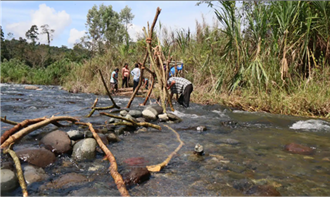
Within the ReAL project, Bribri leaders chose to work on the revitalization of a key cultural practice called Di’katö̀k; this concept could be translated literally as “eating water” and it is often translated as “drying of the river”, however, these translations highly simplify the deep and broader cultural meanings and practices associated with it. Di’katö̀k is a practice that happens once a year; however, for many reasons including state prohibitions, it is not widely practiced. During the Bribri revitalization process, community members learned about the practices of the Elders who guide this process; Elders shared how entire communities participate in Di’katö̀k, to the extent that no one is home during this period. Di’katö̀k is a period where people share food, such as bananas, chicha, and fish and people also share knowledge and community concerns; thus, Di’katö̀k is also a space for community conflict resolution. Practicing Di’katö̀k is part of Bribri governance, Bribri knowledge transmission, and food sovereignty.
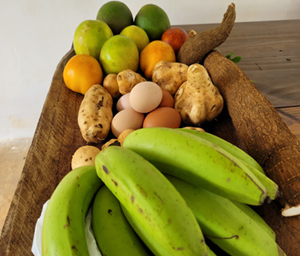
Also, as part of this project, Brörán women carried out multiple workshops regarding Indigenous food sovereignty and these workshops centered strongly around land access, traditional knowledge, and the right to decide on what foods Indigenous nations produce and consume. Food sovereignty was discussed as essential to the continuity of Brörán culture and health, especially due to the poor quality of foods available in local supermarkets which are full of toxic pesticides. The work of women land defenders is of utmost importance; these women have recovered traditional land to ensure access to cultural spaces where women can practice traditional farming and food production, and where women can continue to practice their culture. The Brörán women are also exploring diverse projects related to traditional foods and medicines to ensure greater autonomy.
These three projects are examples of how Indigenous women and Indigenous nations are leading agrarian futures via their local actions. One of the successes of this project has been that the ideas for these projects came from women’s organizations; they were not imposed from external entities. Despite inequitable land access, despite the expansion of industrial farming in Costa Rica that eliminates not only bio but also cultural diversity, and, despite a lack of full implementation of Indigenous rights, women’s land-based practices promote the health of the land, water, and the health of human and non-human beings; these practices are also a examples of a wider project of the defense of life for all of humanity.
Author’s short bio
Olivia Sylvester, Ph.D. (Canada), is Director of the Department of Environment and Development and Associate Professor at the University for Peace. She holds a PhD in Natural Resources and Environmental Management from the Natural Resources Institute of the University of Manitoba (Canada). She also holds an MSc in Biology from the University of Costa Rica and a BSc in Biology from the University of Calgary (Canada). Over the past decade, Dr. Sylvester’s research programme has focused on food sovereignty, agroecology, climate and environmental justice, and gender. Her research is driven by environmental justice and uses critical methodologies to achieve these goals. She has published over 30 peer-reviewed articles, book chapters and new articles and is the editor of three books. With the Bribri Indigenous Nation, she has co-produced videos on development with identity and coordinated the Huétar Indigenous Elders’ book project on cultural knowledge and practices. Dr. Sylvester is coordinator of the following Master’s programmes: 1) Environment, Development and Peace and 2) Ecology and Society.